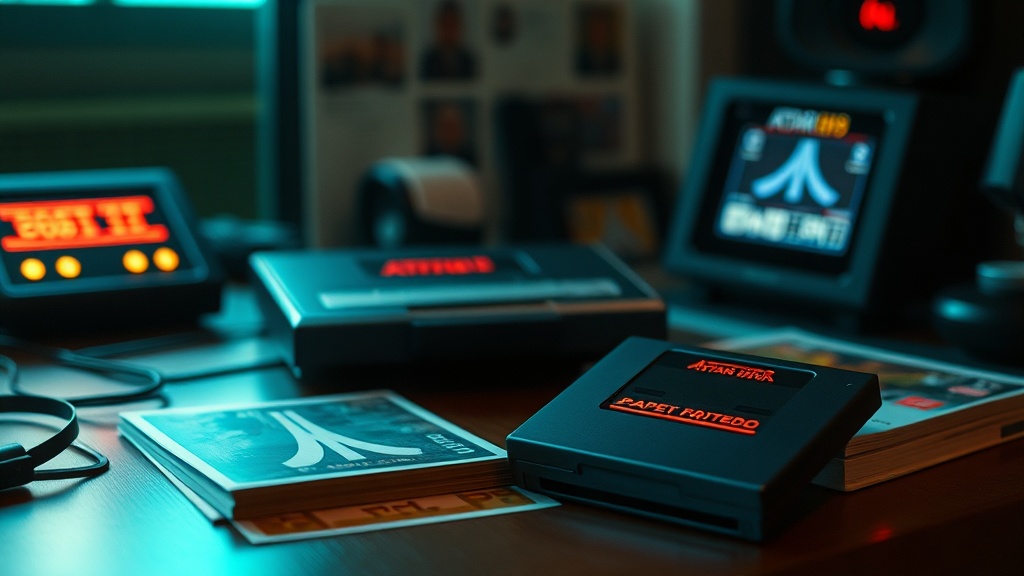
Why Atari Paper Ephemera Belongs Beside Your Cartridges

This guide will help you identify Atari catalogs, brochures, mailers, price sheets, and other paper pieces that collectors still overlook, so you can buy smarter, avoid reproductions, and store the good stuff without flattening what makes it special. Cartridge shelves show what Atari sold. Paper shows how Atari wanted the public to see it — and that difference matters when you're trying to build a collection with context instead of just quantity.
What counts as an Atari paper collectible?
Most collectors start with cartridges, consoles, and controllers, then treat paper as background noise. That's a mistake. Atari paper ephemera covers the disposable material that was meant to move hardware and software out the door: consumer catalogs, fold-out brochures, holiday mailers, dealer sell sheets, warranty cards, registration inserts, price lists, counter cards, and trade-show handouts. None of it was built to survive for forty-plus years, which is exactly why clean examples stand out now.
- Consumer catalogs and mailers show what Atari pushed to families in a specific season.
- Dealer sell sheets and price lists give you timing, wholesale positioning, and model names that often changed fast.
- Warranty cards and inserts help boxed-game collectors complete packages accurately.
- Store posters and counter cards carry display appeal that loose software can't match.
- Press kits and launch brochures tie products to a moment in the company's wider story.
Loose paper gets dismissed because sellers bundle it into "manual lots" or "old paperwork." A sharp 1982 catalog with intact staples, clean color, and no mildew isn't filler. It's a date-stamped snapshot of Atari's own pitch, and it can be tougher to replace than a common cartridge in similar condition.
Why are Atari catalogs and brochures rising faster than many loose cartridges?
Paper was designed to be tossed, folded, thumbed through, taped to a wall, or left in a sunny store window. Cartridges were at least made of plastic. That simple survival gap is one reason paper has moved up quietly. Another is that collectors who've already built respectable game libraries want the material around the games — the ads, order forms, launch imagery, retailer language, and model-year clues that make a shelf feel finished.
Paper tells you when Atari wanted to sound like a toy company, a computer company, or a living-room brand, and that shift is half the fun of collecting it.
I'm not saying every flyer is expensive. Plenty still sell for modest money. The change is in the better copies: unfolded pieces, early VCS material, dealer-facing sheets, and anything with a short print window. Once you filter for strong color, no rust migration at the staples, no tape residue, and complete folds, supply gets thin fast. That's why paper often feels cheap right up until you try to replace the exact piece you passed on last month.
How do you spot original Atari mailers, sell sheets, and dealer flyers?
Start with physical cues before you think about price. Reproductions usually look fine in a small listing photo, then fall apart when you study paper stock, cut quality, and wear patterns. Original Atari print pieces don't all age the same way, but they do tend to age honestly.
Start with paper stock and print quality
Original brochures and catalogs usually have a specific weight, slight surface texture, and period printing traits that modern home or short-run reproductions don't mimic well. Look for rich but not neon color, halftone dots that match offset printing, and folds or saddle staples that make sense for the format. If a seller shows only front and back photos, ask for a close shot of the inside print, edge cut, and any staple area. Repro stock is often too bright, too slick, or too uniform.
Then check aging, folds, and provenance
Real age leaves uneven signs: a soft spine, slight edge toning, one corner bend, or a fold that lines up with how the piece was mailed. Fake aging usually looks theatrical — all-over yellowing, random distress, or coffee-stain nonsense. Provenance helps, too. If a paper lot came from a former retailer, distributor, magazine office, or longtime hobbyist collection, the story often fits the wear. If every copy looks mint but the seller has stacks of them, slow down.
| Piece type | What to inspect first | Common trouble spots | Buying note |
|---|---|---|---|
| Consumer catalog | Staples, cover gloss, page count | Rust bleed, center-page loosening | Check that order forms or subscription cards are still present |
| Dealer sell sheet | Paper weight, fold pattern, back text | Trimmed edges, pinholes, photocopy softness | Odd punch holes can be fine if they fit office filing |
| Warranty card or insert | Dimensions and stock tone | Repro cuts that are too crisp, wrong thickness | Compare against known boxed examples before paying up |
| Retail price list | Date, store name, print method | Brittle folds, tears at creases | Messy but dated originals can be more useful than pristine undated copies |
Before I spend serious money, I like to compare scans or archived examples at Atari Museum or the Internet Archive. Even when the exact piece isn't there, you start to build a feel for period typography, stock, and layout choices.
Where should you look before you pay retail?
The best buys rarely show up under perfect keywords. Sellers who know exactly what they have price accordingly; the better hunting ground is broad, messy inventory. Search for phrases like "Atari paperwork," "video game brochure lot," "computer store flyer," "old electronics mailer," and even retailer names instead of platform names. A regional dealer sheet might never mention "2600" in the title, but the photos will.
- Study reference scans first so you know what's complete and what's supposed to fold where.
- Set saved searches on large marketplaces, then add local classifieds and auction houses that sell paper, toys, or consumer electronics together.
- Watch community sales on AtariAge Forums, where longtime collectors often describe condition more honestly than high-volume resellers.
- Don't skip paper shows, estate sales, and antique malls. Retro-game dealers chase cartridges; paper dealers often don't care that an Atari flyer has a harder audience.
One more rule: buy condition, but buy the right damage. A clean fold on a mailed brochure is normal. Trimmed edges, tape pull, smoky odor, water rippling, or amateur lamination are not. If a piece has to live in a top loader immediately because it wants to crack when opened, price it like a wounded copy, not a display copy.
Which Atari paper pieces are still affordable?
If you're starting now, skip the temptation to chase only the flashiest showroom material. There are still smart entry points that add depth without draining your budget.
- Late 1970s and early 1980s consumer catalogs in collector-grade, not museum-grade, condition: They still turn up often enough to stay reasonable, and they give you a wide product snapshot in one piece.
- Regional dealer price sheets and store circulars: These are often undervalued because they look plain, but they're loaded with dates, bundles, and real-world selling context.
- Box inserts, warranty cards, and registration slips for common titles: They're not glamorous on their own, yet they matter when you start completing boxed games accurately.
- Atari home computer brochures from the 400/800, XL, and XE eras: Computer paper tends to get less love from console-only buyers, which leaves room for patient collectors.
My preference is to buy pieces that answer a question. What did Atari push during a holiday season? How did a retailer bundle paddles, joysticks, or consoles? Which model number showed up in print before a packaging revision? When a paper item tells you something a cartridge label can't, it earns its place.
How should you store and display Atari paper without wrecking it?
Paper needs a different mindset than plastic. You don't want heat, direct sun, basement moisture, cheap PVC sleeves, pressure from overloaded binders, or frames that trap acidic backing. Good storage isn't fancy; it's controlled and boring.
- Use acid-free sleeves, folders, or backing boards sized correctly for the item.
- Keep pieces flat unless they were originally folded and opening them adds stress.
- Store upright only when the sleeve and support board keep the item rigid.
- Rotate anything on display before light fade becomes permanent.
- Write inventory notes on the sleeve, never on the paper.
For display, I like UV-filtering frames or acrylic, a dark wall away from a window, and short runs rather than permanent hanging. If you own something especially fragile, scan it for casual viewing and keep the original flat in archival storage. That's not being precious. It's recognizing that once a fold splits or a bright cover washes out, no cartridge cleaner in the world is bringing it back.
The next time a seller buries a folded Atari brochure under "manual lot" or "old game paperwork," slow down and look closely. Those pieces turn a shelf of plastic into evidence — how Atari priced a system, how it pictured its audience, and how a launch looked before the boxes got opened and the paper disappeared.